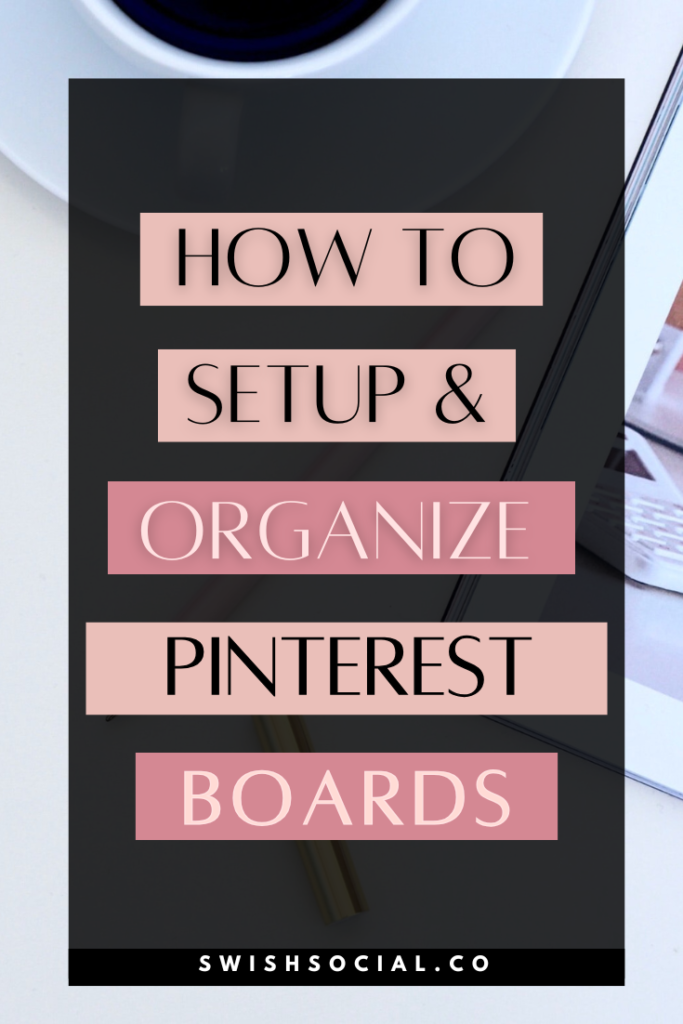
Here’s How to Organize Your boards to Showcase Your Brand
Let’s start with the basics:
Pinterest boards are where your pins live, and they’re the foundation from which Pinterest plucks keywords to sort your pins in search results.
Think of them as the scaffolding that supports your entire Pinterest strategy. Done right, boards can skyrocket your visibility by making your content easy to find and categorize.
Here’s what you need to know about setting up and organizing Pinterest boards for your brand.
Think of Pinterest as Your Favorite Bookstore
Imagine walking into a bookstore like Barnes & Nobles, or Half Price Books. You’ve got an idea of what you might wanna pick up.
You head straight to the section that matches your interest—think of this as your search query. On the shelves, dozens of book covers call for your attention—just like pins do on Pinterest. When you pick up a book, you take a peek at the back, maybe look inside the sleeve for a synopsis to decide if it’s worth bringing home. This is like when your pin is clicked on for a close-up. Then a skim through the first page 

This mirrors the moment someone clicks on your pin again and visits on your site. If they like what they find on your landing page (blog, podcast, or sales page), they’re that much more likely to explore further or make a purchase.
And just like bookstores organize books by genre, Pinterest boards group pins by theme—using strategic keywords. These keywords act as signposts, guiding users directly to your content. Without them, your “book” might get lost in the wrong section, never reaching the audience it’s meant for
Use Keywords Strategically
(Because Visibility on pinterest Isn’t a ‘nice-to-have’, It’s a Strategy)
Pinterest isn’t actually meant to be a social platform; it’s a search engine dressed up in pretty visuals.
Ergo, keywords are the lifeblood of its algorithm and using them strategically starts with research. Use tools like Pinterest’s search bar, keyword research platforms, or even Google’s autocomplete to uncover terms your audience is searching for.
Once you’ve identified the right keywords, incorporate them into your board titles and descriptions—this is how Pinterest pulls context to categorize your pins.
Think of it this way:
just as you’d expect a bookstore to shelve romance novels in the romance section, you want your boards and pins to “shelve” your content where it belongs.
For example, if you’re a wellness coach, “Healthy Recipes for Busy Moms” is far more effective than “Yum Ideas” because it reflects what users are actively searching for. The better your keyword strategy, the higher the chance your content lands in front of the right people.
Keyword rich board titles
Create Themed Boards That Embody Your Brand Identity
Your Pinterest boards should be as polished and cohesive as the rest of your branding. Think of them as your genre sections in that metaphorical bookstore. Each board should tell its own story while seamlessly tying into your overarching brand narrative.
Your boards should be a good representation of your brand as a whole.
Start by listing out the core themes of your business. Are you a coach for mompreneurs? Boards like “Morning Routine Hacks” or “Mindset Shifts” can capture your expertise. Or if you’re a spiritual business coach with a quiz for understanding your energy, boards like “Feminine Energy”, or “Divine Feminine”, or “Energy Healing Spirituality” could all be a fit for housing a pin that links back to that quiz.
SOME THEME EXAMPLES:
- Manifestation Strategies for Business Growth
- Abundance Mindset Practices for Entrepreneurs
- Energy Alignment in Business
- Spiritual Scaling Techniques for Coaches
- Manifestation and Strategy for Entrepreneurs
- Masculine and Feminine Energetics in Business
The key is to align your boards with the actual problems your audience is currently searching to solve, while staying consistent with your brand’s tone and values.
Hyper-specificity is how pinterest puts you in the spotlight of your dream audience,
Next, Curate Only the Cream of the Crop Content
Quality over quantity isn’t just a mantra—it’s an evergreen survival strategy.
While trying to get popular on Pinterest by simply choosing to Pin everything under the sun might make your boards feel cluttered and off-brand. Trends should always be tailored for your brand’s core values. Boards should be considered for evergreen value.
Instead, I want you to treat your boards like a gallery showcasing your best work. A home for each of your links to live.
That’s why it’s important to keep your personal Pinterest separate from your business account.
High-quality content, whether it’s your own or carefully selected saves/repins from others in your niche, reinforces your authority and credibility. Think stunning visuals, engaging captions, and links that deliver on their promise (nothing’s worse than landing on a link that leads to a dead end).
It’s a good idea to start each of your boards off with a handful of pins from other users. Aim for 10-20 pins to start. This curation process strengthens your brand’s reputation as a source of value. As more people see things from your profile, for the keywords you’re aiming to rank for, the more it tells Pinterest that you have stuff people want to see.
Collaborate for Cross-Promotion
One of the simplest ways to collaborate is through group boards. These shared spaces allow multiple contributors to pin content, creating a dynamic blend of ideas and expanding visibility for everyone involved. By pooling your audiences, you not only expand your reach but also build community trust and engagement. Some have options to request. Some have emails to contact them to add you in manually.
Tailwind also has a community feature that allows you to share your pins with other active Tailwind users. This is a great way to spread your pins organically while waiting for Pinterest to sort them out.
Collaboration doesn’t have to mean elaborate campaigns. A well-curated group board or a straightforward cross-promotion effort can work wonders. By leveraging each other’s followers, you create a ripple effect that grows your brand’s presence on the platform. Get creative, boo.
C O N C L U S I O N
Pinterest boards aren’t just containers for your infinite pins, they’re the backbone of a successful Pinterest strategy.
When optimized with the right keywords, crafted into cohesive themes, and filled with high-quality content, they become a powerful tool for driving traffic, engagement, and visibility. Consider adding in strategic collaborations (including Tailwind communities), and you’ll create a ripple effect that grows your brand’s presence on the platform.
Whether you’re just getting started or refining your approach, investing time in organizing and optimizing your boards can pay dividends for years to come. So, build your boards with intention, and let them do the heavy lifting to enchant your audience and amplify your brand’s influence.